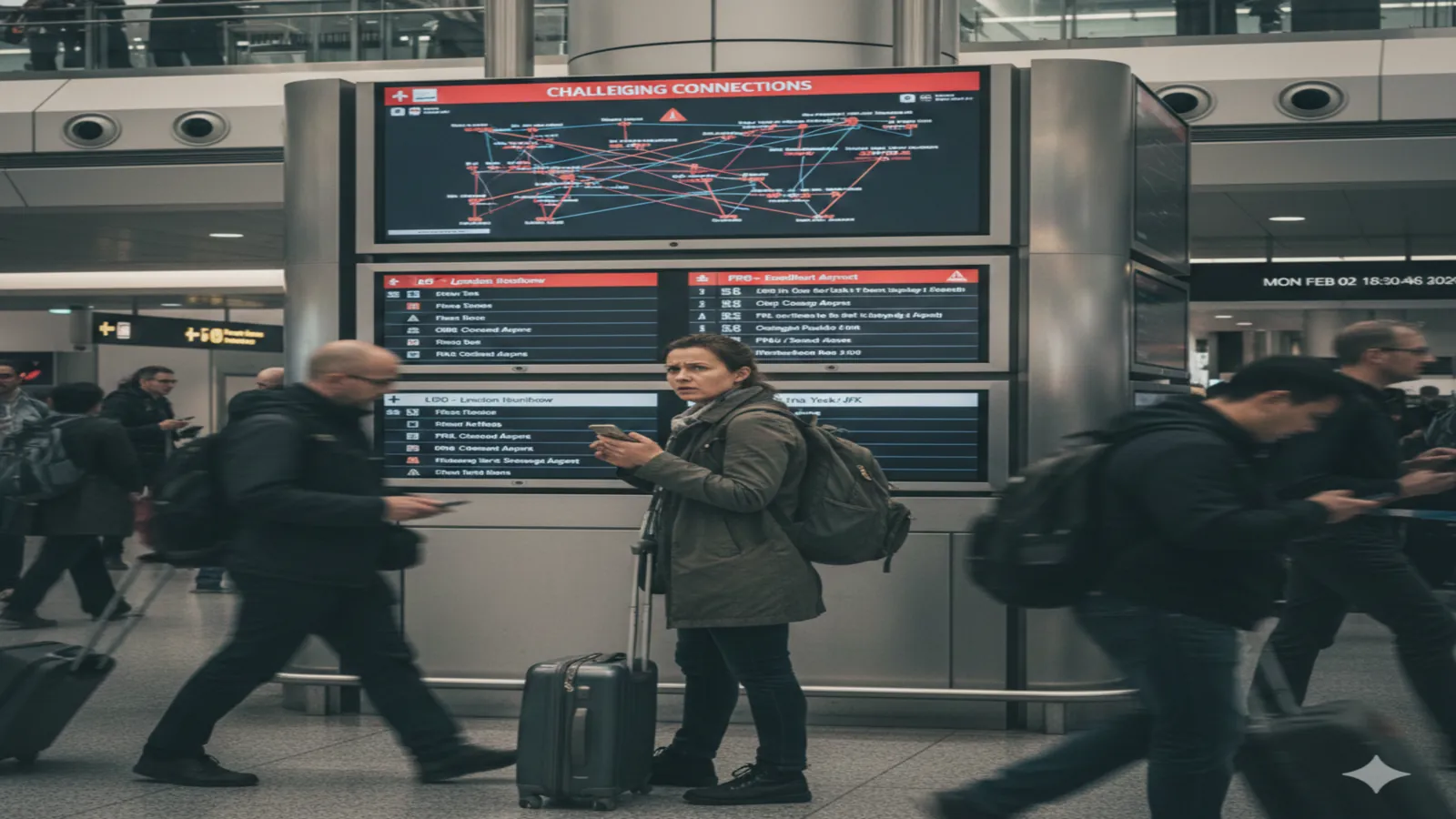
Why Some Airports Are Harder for Connections
Not all airport layovers are created equal. While some airports offer seamless 45-minute connections, others require 2+ hours just to navigate between terminals. Understanding what makes an airport "difficult" can save you from missed flights, expensive rebookings, and travel nightmares.
The most challenging airports typically share these characteristics:
- Multiple disconnected terminals requiring shuttle buses or trains
- Long immigration and customs queues for international arrivals
- Inadequate signage making navigation confusing
- Remote gates requiring additional bus transfers
- Frequent delays due to air traffic congestion
Based on our analysis of minimum connection times, passenger feedback, and airport infrastructure, here are the 10 most challenging airports for connections—and how to successfully navigate them.
1. Madrid-Barajas Airport (MAD) - Spain
The Challenge: Terminal 4 and its satellite T4S are connected by an automatic train that takes 10 minutes. This separation is the primary source of delays for travelers connecting through Madrid.
Why It's Difficult: Most international and Iberia flights use T4S, but the train frequency can create bottlenecks during peak hours. If your inbound flight arrives 5 minutes late and you need to wait 8 minutes for the next train, your 60-minute connection suddenly feels very tight.
Expert Tips:
- For Iberia-to-Iberia connections, never book less than 75 minutes (official MCT is 60, but we recommend more)
- Avoid connections during peak hours (7-9h, 18-21h) when security queues reach 30-45 minutes
- If connecting from T1/T2/T3 to T4, you must take a bus (20-30 min) - these terminals are NOT connected airside
Learn more about Madrid-Barajas Airport and check safe connection times with our MCT Checker.
2. Barcelona-El Prat Airport (BCN) - Spain
The Challenge: BCN operates two separate terminals: the modern T1 serving major airlines, and the older T2 (with modules A, B, C) serving low-cost carriers. The terminals are NOT walking distance.
Why It's Difficult: The shuttle bus between T1 and T2 takes 10-15 minutes and runs every 5-7 minutes. However, during summer months (June-September), Barcelona experiences frequent air traffic control delays that compress connection windows.
Expert Tips:
- If connecting between T1 and T2 (e.g., British Airways to Ryanair), book minimum 2 hours
- Summer travelers should add 30 minutes buffer beyond standard MCT due to endemic ATC delays
- Schengen-to-Schengen within same terminal: 60 min is usually safe; Non-Schengen: allow 90 min minimum
Visit our Barcelona Airport guide for terminal maps and transport information.
3. Miami International Airport (MIA) - USA
The Challenge: MIA is a major international gateway where thousands of passengers must clear US Customs and Immigration simultaneously. The customs hall can be chaotic during peak arrival times.
Why It's Difficult: If you're arriving internationally and connecting to a domestic US flight, you must collect your bag, clear customs, re-check your bag, and undergo TSA security screening again. This process routinely takes 90-120 minutes during busy periods.
Expert Tips:
- International → Domestic connections: book MINIMUM 2 hours, preferably 2.5-3 hours
- Use Mobile Passport Control app if eligible (US/Canadian citizens) to skip some immigration lines
- The MIA Mover train connects terminals in 2-3 minutes, but you cannot walk between terminals
- Morning arrivals from Latin America (8-11h) face the longest customs queues
Check out our full Miami Airport guide for more connection advice.
4. Paris Charles de Gaulle Airport (CDG) - France
The Challenge: CDG's Terminal 2 alone has seven sub-terminals (2A, 2B, 2C, 2D, 2E, 2F, 2G), and navigating between them can be confusing and time-consuming.
Why It's Difficult: Terminal 2E is particularly notorious for its "satellite" gates (K, L, M) which require shuttle buses. The airport's complex layout and frequent congestion make tight connections risky.
Expert Tips:
- Connections within Terminal 2E satellite gates require minimum 75 minutes
- If changing terminals (e.g., 2E to 2F), allow 90 minutes minimum
- Non-Schengen connections can require passport control even when staying airside
- The CDGVAL automated train connects some terminals but doesn't serve all sub-terminals
Plan ahead with our Terminal Finder tool.
5. London Heathrow Airport (LHR) - UK
The Challenge: Heathrow operates 4 terminals (2, 3, 4, 5) located far apart. Terminal changes require exiting security, taking buses or trains, and re-screening.
Why It's Difficult: Unlike many airports where terminals are connected airside, Heathrow terminals are largely isolated. A connection from Terminal 5 (British Airways hub) to Terminal 3 (Virgin, Delta, etc.) requires leaving security, taking the Heathrow Express or Elizabeth Line, and going through security again.
Expert Tips:
- Same-terminal connections (especially T5): 60-75 minutes is usually safe
- Different terminal connections: book minimum 90 minutes, preferably 2 hours
- Terminal 5 is efficiently designed for British Airways connections
- Check your terminal in advance - Heathrow changes terminal assignments occasionally
See our London Heathrow guide for detailed terminal information.
6. Frankfurt Airport (FRA) - Germany
The Challenge: Frankfurt's remote Z gates require a 10-minute bus ride fromthe main terminal. These gates typically handle non-Schengen flights.
Why It's Difficult: The bus to Z gates doesn't run continuously - it departs every 10-15 minutes. If you just miss one, you'll wait. Additionally, Frankfurt experiences significant air traffic congestion, causing frequent inbound delays that compress connection windows.
Expert Tips:
- Connections involving Z gates: add 20 minutes to standard MCT
- Schengen-to-Schengen within main terminals: 45 minutes is usually sufficient
- Non-Schengen connections: allow 60 minutes minimum, 75 if involving Z gates
- Lufthansa dominates Frankfurt and their connections are generally well-coordinated
Check connection requirements at our Frankfurt Airport page.
7. Amsterdam Schiphol Airport (AMS) - Netherlands
The Challenge: While Schiphol has a reputation for efficiency, its single-terminal layout with extremely long concourses can make tight connections challenging, especially during peak European travel hours.
Why It's Difficult: Gates D and E can be a 15-20 minute walk from Gates B and C. Security checkpoints within the terminal (for non-Schengen flights) often have long queues. Additionally, Schiphol frequently experiences departure delays due to slot congestion.
Expert Tips:
- Official MCT is 40 minutes (Schengen) or 50 minutes (non-Schengen), but these are very tight
- For connections between far gates (e.g., D-to-B), allow 60 minutes minimum
- Non-Schengen departures require passport control which can have 20-minute queues
- KLM connections are prioritized and generally reliable if you meet MCT
Visit our Amsterdam Airport guide for more details.
8. Athens International Airport (ATH) - Greece
The Challenge: Athens has a main terminal and a satellite terminal connected by bus. Non-Schengen flights often use the satellite, requiring an additional 5-10 minute bus ride.
Why It's Difficult: The bus schedule to the satellite terminal isn't always frequent, and delays are common during summer peak season when Athens handles maximum capacity.
Expert Tips:
- If your connection involves the satellite terminal, add 15-20 minutes to your planning
- Schengen-to-Schengen in main terminal: 45 minutes is usually safe
- Non-Schengen or satellite terminal: allow 75 minutes minimum
- June-August sees the highest passenger loads and longest queues
Learn more at our Athens Airport page.
9. New York JFK Airport - USA
The Challenge: JFK has 6 terminals that are NOT connected airside. Terminal transfers require exiting security, taking the AirTrain, and re-screening.
Why It's Difficult: If you're connecting between airlines in different terminals (e.g., Delta in T4 to JetBlue in T5), you must allow significant time. The AirTrain is free and runs frequently, but the TSA security recheck can take 30-45 minutes during peak times.
Expert Tips:
- Same-terminal connections (e.g., Delta-to-Delta in T4): 60 minutes is usually sufficient
- Different terminal connections: allow minimum 2 hours, preferably 2.5 hours
- International arrivals face US Customs - add at least 90 minutes for international→domestic
- Terminal 4 (Delta hub) is most efficient for connections
Explore our JFK Airport guide for terminal maps.
10. Los Angeles International Airport (LAX) - USA
The Challenge: LAX's Tom Bradley International Terminal (TBIT) is partially connected to other terminals, but connections remain complex due to the airport's horseshoe layout.
Why It's Difficult: If arriving internationally at TBIT and connecting to a domestic flight in Terminal 1, 6, 7, or 8, you may need to collect bags, clear customs, exit to landside, walk or shuttle to your terminal, and recheck bags. This process can take 90 minutes even without delays.
Expert Tips:
- TBIT to domestic terminals: allow minimum 2 hours for US Customs and terminal transfer
- Same-airline connections within TBIT or Terminal 4-8 complex: 75 minutes is usually safe
- Avoid LAX connections during rush hours (8-10h, 16-19h) when traffic delays are common
- The LAX-it rideshare pickup area is far from terminals - factor this in if not connecting
Check our LAX Airport guide for detailed information.
General Tips for Navigating Difficult Connections
Regardless of which airport you're connecting through, these universal strategies will help:
- Check Minimum Connection Times - Use our MCT Checker to verify if your connection is legal according to airline rules
- Add Buffer Time - If MCT is 60 minutes, book 90 minutes. The extra cushion is worth it
- Know Your Terminals - Use our Terminal Finder to identify which terminal your flights use
- Travel Light - Carry-on only connections are always faster than waiting for checked bags
- Download Airport Apps - Most major airports have apps with live terminal maps and wait times
- Consider Travel Insurance - Missed connection coverage can reimburse hotels and rebooking fees
The Bottom Line
While these 10 airports present significant challenges for connecting passengers, millions of travelers successfully navigate them every day. The key is understanding each airport's specific pain points and planning accordingly.
Always verify your connection time is adequate using our Minimum Connection Time Checker, and when in doubt, choose the longer layover. A 3-hour connection might feel excessive when booking, but it beats sleeping in an airport terminal because you missed your flight.
For detailed information about any airport worldwide, explore our comprehensive airport database with data on over 9,000 airports globally.